Must Every Teacher Understand Inclusion?
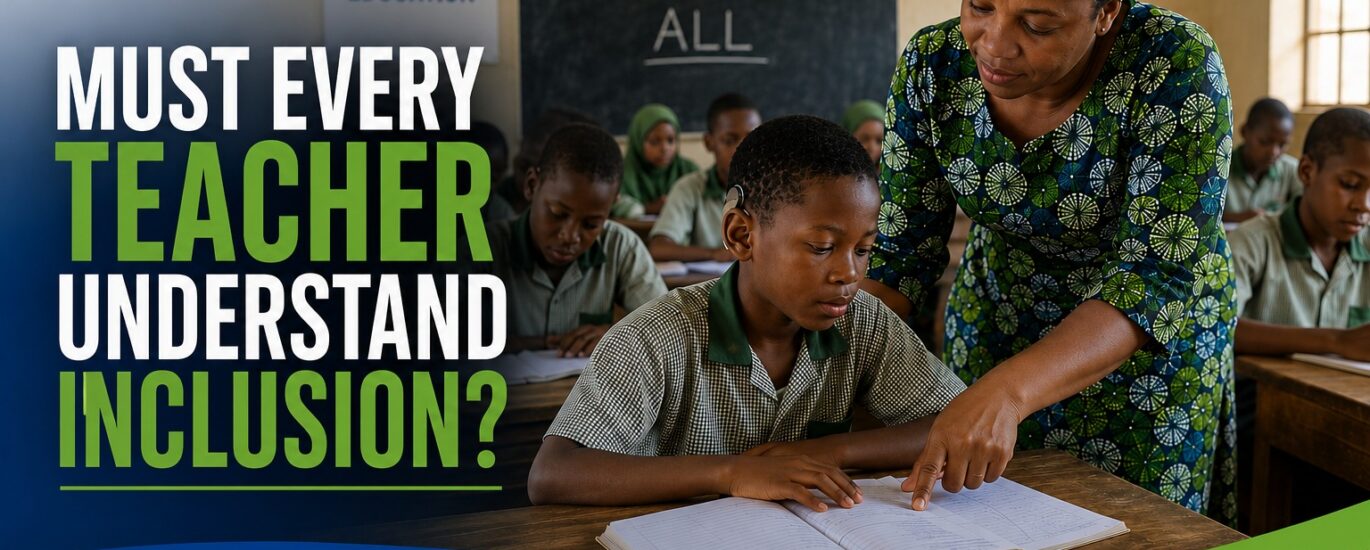
Picture a Primary 4 classroom in Kano State, Nigeria. Thirty-eight pupils are squeezed into a room built for twenty-five. Near the back, a boy named Emeka sits quietly — not out of discipline, but because he cannot hear the teacher clearly. He was born with partial hearing loss, has never been formally assessed, and his teacher, overburdened and under-resourced, has not noticed. By the end of the term, Emeka is labelled “slow.” His parents are advised to transfer him to “a school for his kind.”
Now picture a different classroom — in suburban Ohio, in a London comprehensive, in a school outside São Paulo, in Mumbai. A child who learns differently, speaks a different home language, carries an undiagnosed condition, or simply does not fit the imagined “typical” student is misread, mislabelled, or quietly pushed to the margins. The accents change. The underlying failure does not.
This is not a regional anecdote. It is a pattern repeated daily in classrooms across nearly every country on earth. And at the centre of every one of them stands a teacher — either equipped to make a difference, or not.
So: must every teacher understand inclusion? The answer is not simply yes. It is urgently, irreversibly, and without exception — yes, everywhere.
—
What Is Inclusion, Really?
Inclusive education is not a classroom management strategy. It is not about placing a child with a disability at the back of a regular class and calling it integration. The UNESCO definition is clear: inclusion is a process of addressing and responding to the diversity of needs of all learners through increasing participation in learning, cultures, and communities, and reducing exclusion within and from education.
This means every child — regardless of disability, gender, ethnicity, religious background, language, socioeconomic status, or learning difference — has a right to quality education in the same learning environment as their peers.
For every teacher, in every country, this is not an abstract principle. It is a daily, practical responsibility.
—
The Numbers the World Cannot Ignore
The statistics are sobering, and they span every region.
According to UNESCO’s 2026 Global Education Monitoring Report, *273 million children and youth worldwide* are currently out of school — meaning roughly *one in six* school-aged children globally is excluded from education. This figure has risen for seven consecutive years, driven by population growth, conflict, and shrinking education budgets, even as completion rates among enrolled students have improved.
The same report shows real but uneven progress on inclusion as a policy matter: since 2000, the share of countries with inclusive education laws has risen from just 1% to 24%, and the share with a formal definition of inclusive education has grown to 84%. Yet having a law on paper is not the same as having a teacher in the classroom equipped to apply it — and that gap is where children fall through.
The World Health Organisation estimates that *15% of the world’s population* — well over a billion people — lives with some form of disability. Globally, children with disabilities remain significantly more likely to be out of school than their non-disabled peers, a pattern documented across high-, middle-, and low-income countries alike, though the scale of exclusion is starkest where resources and trained personnel are scarcest.
Regional disparities remain stark: roughly *33% of school-aged children in low-income countries* are out of school, compared to just 3% in high-income countries — and more than half of all out-of-school children and adolescents worldwide live in sub-Saharan Africa, with Nigeria alone accounting for one of the largest single national totals. In Nigeria specifically, UNICEF estimates approximately *10.5 million children* of primary school age are out of school, the highest number of any single country.
Gender adds another global axis of exclusion. UNESCO notes that globally there are now more out-of-school boys than girls overall, but this masks sharp regional reversals: in parts of South Asia, the Middle East, and Nigeria’s north-west and north-east zones, girls’ secondary enrolment falls well below 50%, driven by early marriage, cultural norms, and insecurity. An inclusive teacher, anywhere, must recognise gender as an axis of exclusion alongside disability, language, and poverty.
—
What Happens When Teachers Do Not Understand Inclusion
The Emeka scenario is not unique to Nigeria. Here is what exclusion looks like in real classrooms across the world:
-The child with dyslexia — in Kano or in Kansas — who is punished or shamed for reversing letters, labelled “slow,” and eventually disengages from school entirely, when all he needed was a structured phonics-based approach and a teacher who understood learning differences.
-The migrant or minority-language child — a Fulani girl in northern Nigeria who speaks Fulfulde at home, a Syrian refugee child in a German classroom, a Spanish-speaking child in a Texas school — placed in instruction delivered in a language they barely understand, with a teacher who interprets silence as poor intelligence rather than a language barrier.
-The child with autism — whether in a Lagos public school or a mainstream classroom in Manchester — overwhelmed by noise and sensory input, whose meltdowns are read as defiance, spiritual affliction, or simple misbehaviour, because the teacher has never been trained to recognise autism spectrum presentations.
-The child carrying trauma — from an IDP camp in Borno State, a conflict zone in Ukraine, or a household marked by poverty or violence anywhere in the world — who sits in class but cannot learn, because the teacher has no framework for trauma-informed pedagogy.
Each of these failures looks locally specific. Each is, fundamentally, the same failure: a teacher training gap that leaves educators unequipped to recognise and respond to difference.
—
The Global Policy Consensus Says Teachers Must
The commitment to inclusive education is not merely a national preference in any one country — it is encoded in international consensus. The *Salamanca Statement of 1994, endorsed by more than ninety governments including Nigeria, calls on all countries to adopt inclusive education as a matter of policy and practice. The **UN Convention on the Rights of Persons with Disabilities (2006)* legally obligates ratifying states to ensure inclusive education systems at all levels. Sustainable Development Goal 4 commits UN member states to “inclusive and equitable quality education” for all, by 2030.
National frameworks then translate this global consensus into domestic obligation. Nigeria’s Constitution guarantees the right to education without discrimination, and the Universal Basic Education (UBE) Act mandates free and compulsory basic education for all Nigerian children. The United States enforces the Individuals with Disabilities Education Act (IDEA), guaranteeing students with disabilities a “free appropriate public education.” The United Kingdom’s SEND Code of Practice sets out similar statutory duties for English schools. Most countries with inclusive education laws now have some version of this architecture.
The word “all,” wherever it appears in these frameworks, is not decorative. It is a legal and professional obligation that falls squarely on the shoulders of every classroom teacher, in every signatory country.
Yet implementation consistently lags behind legislation. In Nigeria, a study by the Nigerian Educational Research and Development Council (NERDC) found that fewer than *30% of Nigerian teachers* had received any formal training in special needs education or inclusive pedagogy. Comparable gaps exist elsewhere: OECD data shows that even in wealthier education systems, a meaningful share of teachers report feeling under-prepared to teach students with special educational needs. The gap between policy and classroom practice is a global pattern — and it is teachers who are left to bridge it.
—
What Inclusive Teaching Actually Looks Like
Understanding inclusion does not require a master’s degree in special education. It requires a shift in orientation — from teaching a curriculum to teaching human beings.
Practically, it means:
-Differentiated instruction. A teacher who gives the same lesson the same way to every child in a class of forty is not teaching — she is broadcasting. Differentiated instruction means adjusting content, process, and assessment to meet different learners where they are. It might mean giving oral instructions alongside written ones, or allowing a child to demonstrate knowledge through drawing rather than writing.
-Flexible seating and arrangement. A child with low vision should not be seated at the back. A child with attention difficulties may benefit from a quieter corner. These are not special privileges; they are pedagogical adjustments.
-Cultural and linguistic responsiveness. Whether in a country with hundreds of indigenous languages, like Nigeria, or a classroom with newly arrived migrant or refugee families, a teacher who anchors abstract concepts in familiar cultural references — proverbs, local stories, community knowledge — is already practising a form of inclusion.
-Non-stigmatising classroom language. Terms like “dullard,” “ode,” “slow child,” or “that one” have no place in any classroom. Language shapes identity, and identity shapes learning outcomes.
-Early identification and referral. Teachers are not diagnosticians, but they are the first point of contact. An inclusive teacher notices when something is different — and knows how to refer a child for further assessment rather than writing them off.
—
Professional Bodies and the Inclusion Imperative
Across the world, the bodies that professionalise teaching are increasingly treating inclusion as a core competency rather than a specialism. In Nigeria, the Teachers Registration Council of Nigeria (TRCN) has steadily woven inclusive education principles into its code of conduct and continuing professional development requirements. In the United Kingdom, the Teachers’ Standards require all qualified teachers to adapt teaching to respond to the strengths and needs of all pupils, including those with SEND. In the United States, most state licensure frameworks now require some coursework in differentiated instruction and special education law.
The direction of travel is consistent across these very different systems: understanding inclusion is steadily moving from optional good practice to a defining requirement of what it means to be a qualified, professional teacher, regardless of country.
In the same way that a doctor who does not understand informed consent cannot call herself ethical, a teacher who does not understand inclusion cannot fully claim the title of educator. Teaching is not content delivery. It is the radical act of ensuring that every child in your care has access to learning — regardless of what they bring to the classroom door, and regardless of which country’s classroom door it happens to be.
—
A Word for the Overwhelmed Teacher, Wherever You Teach
This conversation would be dishonest without acknowledging the real constraints teachers operate under, and these constraints take different shapes across the world. For a teacher in Nigeria, it may mean classes of 50, 60, sometimes 80 pupils, crumbling infrastructure, and months of unpaid salary. For a teacher in the United States or United Kingdom, it may mean an under-resourced classroom serving twenty-eight children with five different identified needs and no learning support assistant. For a teacher in a refugee-serving school anywhere, it may mean a classroom of children who arrived with nothing, in a system that gave the teacher little preparation for what they would carry in with them.
The frustration, wherever it arises, is legitimate. But inclusion does not begin with resources — it begins with mindset.
You may not be able to retrofit your school with a ramp, or secure a sign language interpreter, or get a diagnostic assessment scheduled this term. But you can refuse to shame a struggling child. You can learn the warning signs of a learning difficulty. You can seat a visually impaired child closer to the board. You can ask questions in ways that give every child a chance to respond. You can make your classroom a place where difference is not punished.
These are not luxuries reserved for well-resourced systems. They are the baseline of professional teaching, anywhere in the world.
—
Conclusion: The Classroom as a Mirror of the World We Want
Every nation’s future is built — or broken — in its classrooms. A world that educates only the children who fit neatly into a pre-designed mould will always leave millions behind, whether that exclusion happens in Kano, Karachi, Chicago, or Kyiv. A teacher who understands inclusion does not just change a child’s school experience; she changes the trajectory of a life, a family, a community — wherever in the world that classroom sits.
Emeka does not need a “school for his kind.” Neither does the child two thousand miles away facing the same quiet exclusion under a different sky. Every child like him needs a teacher who sees him, understands him, and refuses to let the system make him invisible.
That teacher could be you.
–
This article is written to advance global conversations around inclusive education. For professional development resources on inclusive pedagogy, educators may consult UNESCO’s Global Education Monitoring Report, the UN Convention on the Rights of Persons with Disabilities, and relevant national bodies such as the TRCN (Nigeria), the Department for Education (UK), or equivalent authorities in their own country.